


แถลงข่าวร่วม การประชุมคณะกรรมการชายแดนส่วนภูมิภาคไทย–กัมพูชา (RBC) พิเศษ ว่าด้วยการถอนอาวุธหนักและอาวุธทำลายล้างสูง ระหว่างภูมิภาคทหารที่ 4 แห่งราชอาณาจักรกัมพูชา และกองทัพภาคที่ 2 แห่งราชอาณาจักรไทย
การประชุมคณะกรรมการชายแดนส่วนภูมิภาค (RBC) สมัยพิเศษ ว่าด้วยการถอนอาวุธหนักและอาวุธที่มีอานุภาพทำลายล้างสูง ระหว่างภูมิภาคทหารที่ 4 แห่งราชอาณาจักรกัมพูชา และกองทัพภาคที่ 2 แห่งราชอาณาจักรไทย จัดขึ้นเมื่อวันที่ 31 ตุลาคม 2568 ณ โอเสม็ด จังหวัดอุดรมีชัย ราชอาณาจักรกัมพูชา โดยมีพลโท โปว เฮง ผู้บัญชาการภูมิภาคทหารที่ 4
แห่งราชอาณาจักรกัมพูชา และพลโท วีระยุทธ รักษ์ศิลป์ แม่ทัพภาคที่ 2 แห่งราชอาณาจักรไทย เป็นประธานร่วม และมีคณะผู้สังเกตการณ์อาเซียน (AOT) จากทั้งฝั่งไทยและกัมพูชา เข้าร่วมสังเกตการณ์ในที่ประชุม
สำหรับการประชุมจัดขึ้นตามผลการประชุมคณะกรรมการชายแดนทั่วไป (GBC) ไทย – กัมพูชา สมัยพิเศษ ครั้งที่ 2 เมื่อวันที่ 23 ตุลาคม 2568 และอยู่ภายใต้แนวทางและหลักการของถ้อยแถลงที่ได้ลงนามในการประชุมสุดยอดผู้นำอาเซียน (ASEAN Summit) ณ กรุงกัวลาลัมเปอร์ ประเทศมาเลเซีย เมื่อวันที่ 26 ตุลาคม 2568 โดยนายกรัฐมนตรีของกัมพูชา ไทย และมาเลเซีย ร่วมกับประธานาธิบดีสหรัฐอเมริกา ซึ่งสะท้อนถึงความมุ่งมั่นร่วมกันของทั้งสี่ประเทศในการส่งเสริมความโปร่งใส การสร้างความไว้วางใจ และการบริหารจัดการกำลังทางทหารอย่างมีความรับผิดชอบในภูมิภาค ทั้ง 2 ฝ่ายจึงได้ตกลงร่วมกันในการดำเนินการถอนอาวุธหนักเป็นระยะ (Phased Removal) และมาตรการสร้างความไว้วางใจร่วมกัน เพื่อเสริมสร้าง ความเชื่อใจระหว่างกันและเสถียรภาพตามแนวชายแดนไทย – กัมพูชา โดยได้นิยามและการจำแนกอาวุธ 3 ประเภท ดังนี้
1 ประเภท A หมายถึง ระบบจรวดหลายลำกล้องที่มีตั้งแต่ 2 ลำกล้องขึ้นไป
2 ประเภท B หมายถึง ระบบปืนใหญ่ทุกประเภท ประกอบด้วยระบบปืนใหญ่ลากจูงและปืนใหญ่อัตราจร รวมถึงปืนใหญ่ขนาด 105 มม. 122 มม. 130 มม. 152 มม. และ 155 มม.
3 ประเภท C หมายถึง รถหุ้มเกราะ โดยเฉพาะรถถัง ที่ออกแบบมาเพื่อให้มีการเคลื่อนที่ที่ได้รับการปกป้อง อำนาจการยิงที่เหนือกว่า และกำลังสนับสนุนโดยตรง
ทั้งสองฝ่ายยืนยันเจตนารมณ์ที่จะเคารพซึ่งกันและกัน และปฏิบัติตามผลการประชุม GBC ไทย - กัมพูชา สมัยพิเศษ ครั้งที่ 2 และหลักการในถ้อยแถลงที่ได้ร่วมลงนามเมื่อวันที่ 26 ตุลาคม 2568 อย่างเคร่งครัด
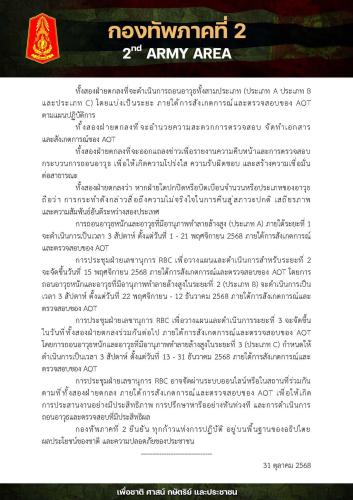
ทั้งสองฝ่ายตกลงที่จะดำเนินการถอนอาวุธทั้งสามประเภท (ประเภท A ประเภท B และประเภท C) โดยแบ่งเป็นระยะ ภายใต้การสังเกตการณ์และตรวจสอบของ AOT ตามแผนปฏิบัติการ
ทั้งสองฝ่ายตกลงที่จะอำนวยความสะดวกการตรวจสอบ จัดทำเอกสาร และสังเกตการณ์ของ AOT
ทั้งสองฝ่ายตกลงที่จะออกแถลงข่าวเพื่อรายงานความคืบหน้าและการตรวจสอบกระบวนการถอนอาวุธ เพื่อให้เกิดความโปร่งใส ความรับผิดชอบ และสร้างความเชื่อมั่นต่อสาธารณะ
ทั้งสองฝ่ายตกลงว่า หากฝ่ายใดปกปิดหรือบิดเบือนจำนวนหรือประเภทของอาวุธ ถือว่า การกระทำดังกล่าวสื่อถึงความไม่จริงใจในการคืนสู่สภาวะปกติ เสถียรภาพ และความสัมพันธ์อันดีระหว่างสองประเทศ
การถอนอาวุธหนักและอาวุธที่มีอานุภาพทำลายล้างสูง (ประเภท A) ภายใต้ระยะที่ 1 จะดำเนินการเป็นเวลา 3 สัปดาห์ ตั้งแต่วันที่ 1 - 21 พฤศจิกายน 2568 ภายใต้การสังเกตการณ์และตรวจสอบของ AOT
การประชุมฝ่ายเลขานุการ RBC เพื่อวางแผนและดำเนินการสำหรับระยะที่ 2 จะจัดขึ้นวันที่ 15 พฤศจิกายน 2568 ภายใต้การสังเกตการณ์และตรวจสอบของ AOT โดยการถอนอาวุธหนักและอาวุธที่มีอานุภาพทำลายล้างสูงในระยะที่ 2 (ประเภท B) จะดำเนินการเป็นเวลา 3 สัปดาห์ ตั้งแต่วันที่ 22 พฤศจิกายน - 12 ธันวาคม 2568 ภายใต้การสังเกตการณ์และตรวจสอบของ AOT
การประชุมฝ่ายเลขานุการ RBC เพื่อวางแผนและดำเนินการระยะที่ 3 จะจัดขึ้นในวันที่ทั้งสองฝ่ายตกลงร่วมกันต่อไป ภายใต้การสังเกตการณ์และตรวจสอบของ AOT โดยการถอนอาวุธหนักและอาวุธที่มีอานุภาพทำลายล้างสูงในระยะที่ 3 (ประเภท C) กำหนดให้ดำเนินการเป็นเวลา 3 สัปดาห์ ตั้งแต่วันที่ 13 - 31 ธันวาคม 2568 ภายใต้การสังเกตการณ์และตรวจสอบของ AOT
การประชุมฝ่ายเลขานุการ RBC อาจจัดผ่านระบบออนไลน์หรือในสถานที่ร่วมกัน ตามที่ทั้งสองฝ่ายตกลง ภายใต้การสังเกตการณ์และตรวจสอบของ AOT เพื่อให้เกิดการประสานงานอย่างมีประสิทธิภาพ การปรึกษาหารืออย่างทันท่วงที และการดำเนินการถอนอาวุธและตรวจสอบที่มีประสิทธิผล
กองทัพภาคที่ 2 ยืนยัน ทุกก้าวแห่งการปฏิบัติ อยู่บนพื้นฐานของอธิปไตย ผลประโยชน์ของชาติ และความปลอดภัยของประชาชน
....................................................................
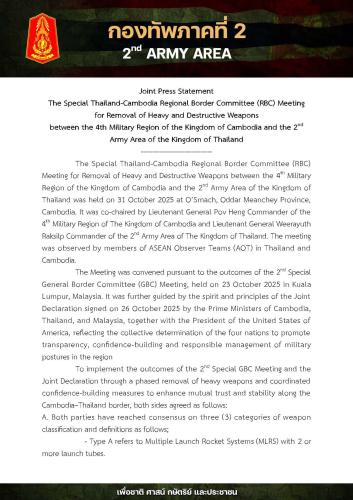
Joint Press StatementThe Special Thailand-Cambodia Regional Border Committee (RBC) Meeting for Removal of Heavy and Destructive Weapons between the 4th Military Region of the Kingdom of Cambodia and the 2nd Army Area of the Kingdom of Thailand
The Special Thailand-Cambodia Regional Border Committee (RBC) Meeting for Removal of Heavy and Destructive Weapons between the 4th Military Region of the Kingdom of Cambodia and the 2nd Army Area of the Kingdom of Thailand was held on 31 October 2025 at O’Smach, Oddar Meanchey Province, Cambodia. It was co-chaired by Lieutenant General Pov Heng Commander of the 4th Military Region of The Kingdom of Cambodia and Lieutenant General Weerayuth Raksilp Commander of the 2nd Army Area of The Kingdom of Thailand. The meeting was observed by members of ASEAN Observer Teams (AOT) in Thailand and Cambodia.
The Meeting was convened pursuant to the outcomes of the 2nd Special General Border Committee (GBC) Meeting, held on 23 October 2025 in Kuala Lumpur, Malaysia. It was further guided by the spirit and principles of the Joint Declaration signed on 26 October 2025 by the Prime Ministers of Cambodia, Thailand, and Malaysia, together with the President of the United States of America, reflecting the collective determination of the four nations to promote transparency, confidence-building and responsible management of military postures in the region
To implement the outcomes of the 2nd Special GBC Meeting and the Joint Declaration through a phased removal of heavy weapons and coordinated confidence-building measures to enhance mutual trust and stability along the Cambodia–Thailand border, both sides agreed as follows:
A. Both parties have reached consensus on three (3) categories of weapon classification and definitions as follows;
- Type A refers to Multiple Launch Rocket Systems (MLRS) with 2 or more launch tubes.
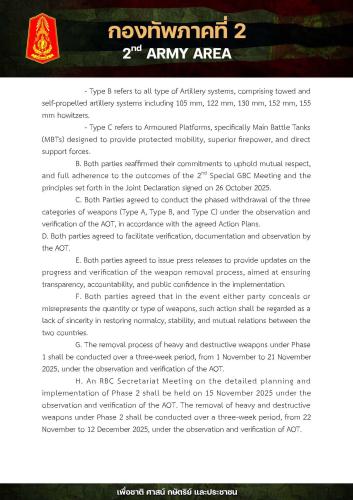
- Type B refers to all type of Artillery systems, comprising towed and self-propelled artillery systems including 105 mm, 122 mm, 130 mm, 152 mm, 155 mm howitzers.
- Type C refers to Armoured Platforms, specifically Main Battle Tanks (MBTs) designed to provide protected mobility, superior firepower, and direct support forces.
B. Both parties reaffirmed their commitments to uphold mutual respect, and full adherence to the outcomes of the 2nd Special GBC Meeting and the principles set forth in the Joint Declaration signed on 26 October 2025.
C. Both Parties agreed to conduct the phased withdrawal of the three categories of weapons (Type A, Type B, and Type C) under the observation and verification of the AOT, in accordance with the agreed Action Plans.
D. Both parties agreed to facilitate verification, documentation and observation by the AOT.
E. Both parties agreed to issue press releases to provide updates on the progress and verification of the weapon removal process, aimed at ensuring transparency, accountability, and public confidence in the implementation.
F. Both parties agreed that in the event either party conceals or misrepresents the quantity or type of weapons, such action shall be regarded as a lack of sincerity in restoring normalcy, stability, and mutual relations between the two countries.
G. The removal process of heavy and destructive weapons under Phase 1 shall be conducted over a three-week period, from 1 November to 21 November 2025, under the observation and verification of the AOT.
H. An RBC Secretariat Meeting on the detailed planning and implementation of Phase 2 shall be held on 15 November 2025 under the observation and verification of the AOT. The removal of heavy and destructive weapons under Phase 2 shall be conducted over a three-week period, from 22 November to 12 December 2025, under the observation and verification of AOT.
I. An RBC Secretariat Meeting on the detailed planning and implementation of Phase 3 shall be held on a date mutually agreed by both parties, under the observation and verification of the AOT. The removal process of heavy and destructive weapons under Phase 3 is planned to be conducted over a three-week period, from 13 December to 31 December, under the observation and verification of the AOT.
J. The RBC Secretariat meeting may be convened either virtually or in person, as mutually agreed by both parties, under the observation and verification of the AOT, to ensure efficient coordination, timely consultation, and effective implementation of the removal and verification process.
 รูปภาพ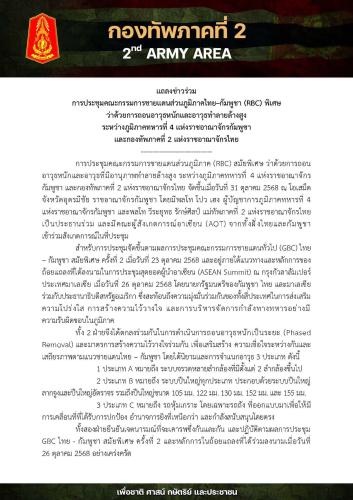



ส่วนบริหารกิจการโทรทัศน์ ภาคกลาง จังหวัดกาญจนบุรี
เลขที่ 151 หมู่ 13 ถนนกาญจนบุรี-อู่ทอง ต.ปากแพรก อ.เมือง จ.กาญจนบุรี 71000
โทรศัพท์ 034-600156
Email: tv11kanchanaburi@gmail.com
สงวนลิขสิทธิ์ พ.ศ.2564 สถานีโทรทัศน์แห่งประเทศไทยจังหวัดกาญจนบุรี
(NBT Central)


